
Argentina's crestfallen players skulked away from Green Point Stadium with their World Cup dreams shattered and their reputations in tatters. Elimination had been inflicted with their heaviest loss in this tournament in 52 years. The muttered assessments offered in the immediate aftermath of defeat were pained.There were admissions from some that might have applied to England's players in the previous round. Diego Maradona pointed to a lack of "energy and freshness" and claimed Germany had been quicker than his charges. Fabio Capello had come to similar conclusions in Bloemfontein six days earlier. Yet lessons are clearly not being learned against this German side."We didn't play as a team, and that was our biggest problem," said Carlos Tevez. "We knew Germany would play on the counterattack, like they did against England, and our mistake was not being able to stop that. It was the fact that we didn't play as a team that cost us. Of course that's what happened – are you stupid? We have some of the top players in the world. Germany and Holland don't have top players, but they won their games and made it as a team."Those celebrated individuals had been inconsolable in the aftermath. Lionel Messi, who followed Wayne Rooney's lead by ending the tournament without a goal to his name, was hugged by Maradona in the dressing room as the tears flowed. The manager himself had to delay his post-match media conference until he had regained his composure and, even then, he was numbed and monotone through the event. "The changing room was full of sadness," said Javier Mascherano. "It was horrible to be in there.""It's not a total failure for us because, until Saturday, we were one of the favourites and I don't think just because we lost this game we should forget everything that came before," added Tevez. "But it was more painful losing this game to Germany than the one four years ago because it was 4-0. Last time was on penalties, but to lose 4-0 in a quarter-final hurts a lot."The World Cup can be cruel. You wake up one day and get up from the wrong side of the bed, and then you're out and going home. A few mistakes and that's it. We knew what Germany would do, that they wouldn't let us attack in the way we wanted to, but we just played badly."They did what they were capable of doing, and we did not. I am very, very sad and disappointed with the result, but I gave everything I could – my heart, my legs, everything I have. But it was not enough." © Guardian News and Media 2010Rampant Germany oust Argentina

Germany are through to the semi-finals after producing another masterful performance to beat Argentina 4-0 at Cape Town’s Green Point Stadium. Diego Maradona’s Albiceleste came into this match with high hopes of avenging their quarter-final defeat in 2006 but they ultimately had no answer to a slick, powerful German side who will now face either Spain or Paraguay in the last four.
Games as eagerly-anticipated as this one often disappoint, but this particular encounter took just three minutes to catch fire as Joachim Low's side snatched an early advantage. Bastian Schweinsteiger provided the assist with a superbly judged inswinging free-kick, and with Sergio Romero caught in no man’s land, Thomas Muller applied the slightest of headed touches to flick the ball into the net. It was Germany’s 200th FIFA World Cup goal, their fastest in 32 years and the quickest so far at South Africa 2010. The only downside for Low’s side was that it left Argentina with 87 minutes to respond.
However, it was the Germans who continued to carve out the better chances, with Miroslav Klose - winning his 100th cap – firing wastefully over from the edge of the box after some outstanding, unselfish set-up play from Muller. Argentina attempted to grab a foothold, with Angel Di Maria and Gonzalo Higuain creating decent shooting positions, but on each occasion Manuel Neuer proved equal to their goal-bound efforts.
Nevertheless, as the match wore on, La Albiceleste relied increasingly on speculative long-range efforts, with the subdued Lionel Messi firing over just before the break and Di Maria missing the left-hand post by a matter of inches with a ferociously-struck 25-yard drive. Germany also remained a constant threat on the break, and Podolski – who had earlier come close to scoring himself – was to lead the counter-attack that provided Low’s team with their all-important second goal.
With the second half reaching its midway point, the Cologne striker broke clear on the left and, from a position where he would have been forgiven for shooting, he instead squared intelligently for Klose to tap home from inside the six yard box. The goal left Argentina with little option but to throw men forward, and with Diego Maradona’s side over-committed, Germany proceeded to pick them off on the break.
Within six minutes of Klose making it two, Arne Friedrich removed any lingering doubts over the outcome with another close-range finish, profiting on this occasion from a dazzling solo run from the excellent Schweinsteiger. There was even time for Klose to rub salt into Argentinian wounds, side-footing home Mesut Ozil's measured cross with a minute remaining to round off a memorable German win.

The first Brazilian own goal in 97 World Cup matches, off the head of Felipe Melo, set up a victory in which Holland avenged their defeat at the hands of the South Americans in the 1998 semi-finals. Now the inquests will start on Dunga's regime after Bert van Marwijk's side won through to the last four with a victory in which Arjen Robben's skills proved decisive. The Bayern Munich winger had a role in setting up both goals, the second of them scored by Wesley Sneijder, while also provoking Melo into a stamp that saw Brazil playing the last 17 minutes a man short.
Brazil crashes out
On the eve of the match Dunga and Van Marwijk had been unanimous in their declaration that total football and samba football were archaic concepts with no relevance to the present day. And from the moment Juan barged Robin van Persie out of the path of Dirk Kuyt's looping cross in the opening minute, this was always going to be a match with an edge.There was a late change for Holland when Joris Mathijsen, who had played all four of their previous games partnered by John Heitinga in the middle of the Oranje defence, suffered a knee injury in the warm-up and was replaced by Andre Ooijer, formerly of Blackburn Rovers. The change may have had some influence on the opening goal, which came in the 10th minute when Melo, from inside his own half, measured a straight ball that invited Robinho to run between the two centre-backs and stroke the ball past Maarten Stekelenburg from 15 yards as unfussily as a man peeling a ripe banana.Brazil had two chances to increase their lead before the interval, first when a right-wing corner was returned to Daniel Alves, whose cross was met by Juan with a first-time drive that just cleared the crossbar, and then when Robinho's persistence provided an opening for Kaká, whose curling right-foot shot was turned around the post by the diving Stekelenburg.For Holland there were no such clear-cut openings by that stage. Every time Robben, stationed wide on the right, turned inside to try and exploit his strong left foot, he found himself running helplessly into a thicket of three powerful defenders.It was the breakdown of one of Brazil's best combination moves, involving Kaká, Robinho and Luís Fabiano, that led to Holland's equaliser after 53 minutes. Robben finally found himself one-on-one with Michel Bastos, who had been booked in the first half for persistently fouling the Dutch winger. Going to ground this time under minimal contact, Robben turned the free-kick back to Sneijder, who delivered a long head-height diagonal ball into the middle and watched as Júlio César's attempt to punch clear was impeded by the jump of Melo, the ball skimming off the top of the defender's head and into the net.Robben's increasing ability to sow panic on the left flank of the Brazil defence paid further dividends after 68 minutes, when he swung in a corner from the right that Kuyt, at the near post, glanced on to Sneijder, who had no need to jump in order to guide the ball home. Five minutes later Melo's stupidity saw Brazil reduced to 10 men and no longer able to mount the coherent attacks that might have kept them in the competition.
Brazil crashes out
On the eve of the match Dunga and Van Marwijk had been unanimous in their declaration that total football and samba football were archaic concepts with no relevance to the present day. And from the moment Juan barged Robin van Persie out of the path of Dirk Kuyt's looping cross in the opening minute, this was always going to be a match with an edge.
Hodgson new Liverpool manager

Hodgson new Liverpool manager

Liverpool officially appointed Roy Hodgson as their new manager on Thursday.As had been widely expected, the 62-year-old agreed to leave his job in charge at Fulham and signed a three-year contract, replacing Rafael Benitez, who left the Premier League club last month.“This is the biggest job in club football and I’m honoured to be taking on the role of manager of Britain’s most successful football club,” Hodgson told the club’s official website.“I look forward to meeting the players and the supporters and getting down to work at Melwood.”Hodgson’s first task will be to convince some of his biggest players, including Steven Gerrard and Fernando Torres, to stay at the club.Liverpool finished seventh in the English Premier League last season, failing to qualify for the Champions League.
Villa and Ronaldo: A tale of two sevens

A flash of a Spanish boot and a dash of Portuguese saliva on a chilly Cape Town evening summed up the contrasting fortunes of two of the World Cup’s most-prominent number sevens.
Cristiano Ronaldo appeared to spit at the feet of a cameraman after Spain’s 1-0 victory over Portugal in the round of 16 on Tuesday sent the former World Player of the Year packing. It was a phlegm full-stop on a campaign in which the superstar shone as brightly as a cheap plastic torch with leaky batteries.
Spain’s David Villa, on the other hand, is in danger of going supernova.
The 28-year-old is joint top scorer at the World Cup with four goals — representing 80 per cent of Spain’s tally so far — and will continue to tussle with Argentina’s Gonzalo Higuain for the Golden Boot.
Only a fool would bet against the miner’s son becoming Spain’s all-time top scorer — quite possibly at this tournament.
He has already scored 42 goals in 62 appearances for his country, two behind Raul, and was top scorer at the 2008 European Championships as Spain cast aside years of underachievement to triumph.
Villa, known as “The Kid” in the language spoken in his home region of Asturias, has been equally prolific throughout his club career at Real Zaragoza and Valencia.
The player himself is low-key — unlike Ronaldo, you do not see him fronting countless advertising campaigns — and dismissive of the praise heaped upon him.
“With teammates like that, everything is easier,” he said as he left Green Point stadium on Friday. “We have 23 players who could play for any national team, but we are lucky to have them with us.”
Villa has a point considering Spain can call on quality players such as his new Barcelona teammate Xavi Hernandez while leaving the likes of Arsenal’s Cesc Fabregas on the bench. But the Spanish media is in no doubt about his worth — especially considering the below-par performances of golden boy Fernando Torres in South Africa.
“Villa, like few people in front of goal, is a goldmine, or even better, an oilfield on his own,” Spanish daily El Pais wrote of him.
Ironically, some of Villa’s prowess may be down to a childhood accident that could have prevented him playing at all.
At the age of four, Villa broke his right leg. But even in plaster he refused to stop playing football. His father taught him to kick with his weaker left leg, making him just as comfortable with the ball at either foot.
This coupled with his movement, touch and finishing, makes him one of the most-deadly strikers in the game — which is why Barcelona lashed out 40 million euros (49.1 million dollars) for his services next season.
Villa’s move raises the prospect of a longer-term battle with Ronaldo, who plays for the Catalan side’s deadly rivals Real Madrid.
But first Ronaldo will have to shake off the pain of captaining a Portugal side that showed little imagination in attack; aside from the 7-0 thumping of North Korea, they failed to score in their three other games.
“I am completely devastated, frustrated and feel an unimaginable sadness,” he said in a statement on the website of Gestifute, owned by his agent.
It would be unfair to lay the blame for the poor international performances solely at the feet of Ronaldo.
At Manchester United, he prospered in an attacking line-up backed by world-class players, but Portugal boss Carlos Queiroz plays a self-confessed “pragmatic” game, with an emphasis on packing his own half and counter-attacking.
After the game, Ronaldo told reporters to ask Queiroz to explain the defeat, but later denied this was intended as criticism.
“When I said put the question to the coach, it is just because Carlos Queiroz was holding a press conference,” he said. “I am a human being, and like any human being I suffer and I have the right to suffer alone.”
2010 FIFA World Cup: 10 Overrated Players Who Don't Deserve Call-Ups
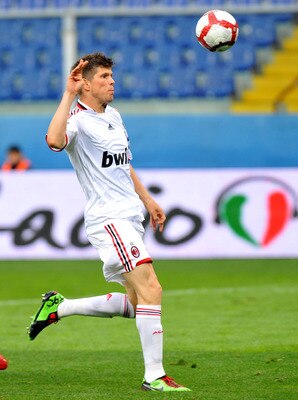
The 2010 FIFA World Cup is where stars collide to give their all in search of World Cup glory.
Many players come regarded as their teams go to guy in tough times, many just need impact subs, some teams just need hard men to boss the middle of the pack.
Sadly some players do not even deserve to feature in the World Cup because of inadequate preparations.
Players who have not played the game in a while, some who just recovered from long term injury, others who just walked their way into the team by doing nothing but using past achievements.
In no particular order, here are 10 players who should be somewhere else but donning a jersey at the World Cup.
Begin Slideshow

No comments:
Post a Comment